Paediatrics / Neonatology
Newborn Examination
A structured OSCE guide to the routine newborn examination, including preparation, focused history, Apgar score, measurements, head-to-toe examination, primitive reflexes, hip screening, red flags and examiner questions.
Case Scenario
You are the junior doctor on the postnatal ward. A term baby has been delivered by normal vaginal delivery. The midwife asks you to perform a routine newborn examination before discharge.
The baby is currently well, feeding, passing urine and stool, and has no immediate concerns reported by the mother.
Student Task
Perform a structured newborn examination. Assess the baby from head to toe, identify normal and abnormal findings, and explain your findings clearly to the parent.
Timing and Aims
A detailed newborn examination should be performed before discharge, ideally within the first 24–72 hours of life. A further baby check is usually performed later in infancy, commonly around 6–8 weeks, to detect abnormalities that may not be obvious immediately after birth.
Aims
- Identify congenital abnormalities
- Detect birth injuries
- Assess cardiorespiratory stability
- Check feeding, urine and stool passage
- Identify signs of infection or jaundice
- Screen for conditions requiring early referral
- Reassure and educate the parents
Preparation
- Wash your hands.
- Ensure the room is warm, private and well lit.
- Introduce yourself to the parent.
- Confirm the baby’s identity using the name band and date of birth.
- Explain that you will examine the baby from head to toe.
- Gain consent.
- Ask the parent to undress the baby down to the nappy.
- Keep the baby warm throughout the examination.
- Ask whether the parent has any concerns.
Example explanation
“I am going to examine your baby from head to toe. I will check the heart, lungs, abdomen, hips, eyes and general development. I will keep your baby warm and only expose the areas I need to examine.”
Brief History Before Examination
Pregnancy history
- Gestational age
- Antenatal scan abnormalities
- Maternal diabetes
- Maternal hypertension or pre-eclampsia
- Maternal infections
- Group B streptococcus risk
- Reduced fetal movements
- Medication, smoking, alcohol or drug exposure
- Breech presentation
Delivery history
- Date and time of birth
- Mode of delivery
- Prolonged rupture of membranes
- Meconium-stained liquor
- Instrumental delivery
- Shoulder dystocia
- Need for resuscitation
- Apgar scores
- Birth weight
- Any birth trauma
Postnatal history
- Feeding method and feeding frequency
- Difficulty latching or poor suck
- Vomiting
- Breathing difficulty
- Cyanosis
- Jaundice
- Urine output
- Passage of meconium
- Temperature instability
- Excessive sleepiness or irritability
Family history
- Congenital heart disease
- Developmental dysplasia of the hip
- Childhood hearing problems
- Congenital cataracts
- Renal disease
- Genetic or metabolic disease
- Neonatal deaths
Apgar Score
The Apgar score assesses the newborn shortly after birth, usually at 1 minute and 5 minutes. It scores appearance, pulse, grimace, activity and respiration. It should not delay resuscitation. If the baby needs resuscitation, begin immediately.
| Component | 0 points | 1 point | 2 points |
|---|---|---|---|
| Appearance | Blue, pale or cyanotic | Pink trunk with blue extremities | Completely pink |
| Pulse | Absent | < 100 beats/min | ≥ 100 beats/min |
| Grimace | No response | Grimace | Cry, cough or active withdrawal |
| Activity | Limp, no movement | Some flexion | Active movement and flexion |
| Respiration | Absent | Weak, irregular or gasping | Regular breathing with strong cry |
A score of 7–10 is generally reassuring. A score of 4–6 suggests moderate abnormality. A score of 0–3 is low and suggests significant neonatal compromise. If the 5-minute score remains below 7, reassessment is continued at 5-minute intervals as clinically required.
Measurements and Vital Signs
Review or measure the baby’s weight, length, head circumference, temperature, heart rate and respiratory rate. Check oxygen saturation if there are signs of cyanosis, respiratory distress, murmur or poor perfusion.
| Parameter | Typical term newborn value |
|---|---|
| Weight | Around 3–4 kg |
| Length | Around 50 cm |
| Head circumference | Around 35 cm |
| Respiratory rate | Around 40–60 breaths/min |
| Heart rate | Around 120–160 beats/min |
Plot weight, length and head circumference on the appropriate growth chart. Classify weight as small for gestational age, appropriate for gestational age, or large for gestational age.
If the baby is small, assess whether growth restriction appears symmetrical or asymmetrical by considering weight, length and head circumference together.
Urine, Meconium and Weight Loss
- The first urine should usually be passed within the first 24 hours.
- Meconium is the dark green-black first stool.
- Meconium should usually be passed within the first 24–48 hours.
- Failure to pass urine or meconium requires further assessment.
- Mild weight loss after birth is normal.
- A weight loss of up to around 7% in the first few days can be physiological.
- Most babies regain birth weight by around 10–14 days.
- Encourage feeding support and breastfeeding counselling where appropriate.
General Inspection
Observe before touching the baby.
- Alertness
- Colour
- Cry
- Posture
- Tone
- Spontaneous movement
- Respiratory distress
- Dysmorphic features
- Obvious congenital abnormalities
A normal newborn should be pink, active, well perfused and moving all four limbs symmetrically.
Skin
- Inspect for pallor, central cyanosis and jaundice.
- Look for bruising, lacerations, birthmarks, rashes and vernix.
- Check for signs of infection.
- Document bruises, birthmarks and marks clearly, including site and size.
- Jaundice in the first 24 hours is pathological until proven otherwise.
Common normal findings
- Caput succedaneum
- Mild moulding
- Milia
- Erythema toxicum
- Vernix
- Epstein pearls
- Salmon patch
- Slate-grey nevus
- Small subconjunctival haemorrhage
- Breast bud enlargement
- White vaginal discharge
- Small amount of vaginal bleeding
- Simple low sacral dimple close to the anus
- Mild physiological weight loss
Head
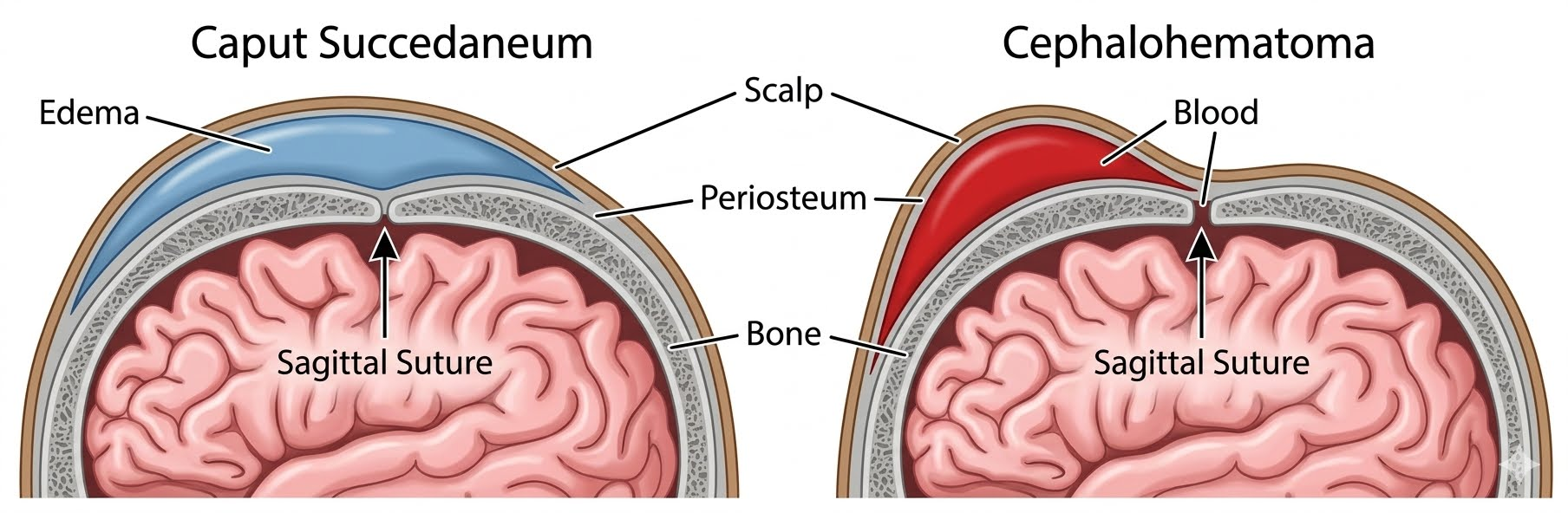
Inspect the head size and shape. Measure and plot the head circumference. Palpate the sutures and fontanelles.
- Moulding is common after delivery and usually resolves.
- Caput succedaneum is soft tissue swelling and may cross suture lines.
- Cephalohaematoma is bleeding beneath the periosteum and does not cross suture lines.
- Cephalohaematoma may increase the risk of jaundice.
- Subgaleal haemorrhage is serious because it can cause significant blood loss.
- A flat anterior fontanelle is normal.
- A bulging fontanelle may suggest raised intracranial pressure.
- A sunken fontanelle may suggest dehydration.
Face, Eyes, Ears, Nose and Mouth
Face
- Inspect for facial symmetry.
- Look for facial nerve palsy.
- Look for dysmorphic features.
- Check for cleft lip and birth trauma.
- Observe facial movement when the baby cries.
Eyes
- Inspect for discharge, redness, scleral jaundice and subconjunctival haemorrhage.
- Look for corneal clouding, cataract, ptosis or abnormal eye position.
- Check the fundal reflex in both eyes.
- The fundal reflex may not always appear red, depending on skin pigmentation.
- An absent reflex or white reflex requires urgent ophthalmology referral.
Ears
- Inspect ear position, shape and symmetry.
- Look for skin tags, pits or accessory auricles.
- Confirm that newborn hearing screening has been arranged or completed.
Nose
- Assess nasal patency.
- Look for nasal flaring, noisy breathing, cyanosis or difficulty feeding.
- Bilateral nasal obstruction can cause respiratory distress in newborns.
Mouth and palate
- Inspect for cleft lip.
- Visualise the hard and soft palate.
- Do not rely only on palpation to exclude cleft palate.
- Look for tongue-tie, Epstein pearls, oral thrush and gum abnormalities.
- Check that the uvula and posterior palate are intact.
Neck, Clavicles and Upper Limbs
Neck and clavicles
- Inspect for webbing, short neck, swelling, cystic hygroma or neck masses.
- Palpate both clavicles.
- Look for tenderness, crepitus, deformity or reduced arm movement.
- Clavicle fracture can occur after difficult delivery, especially shoulder dystocia.
Upper limbs
- Inspect both arms for symmetry, size and length.
- Assess spontaneous movement and tone.
- Count the fingers.
- Look for polydactyly, syndactyly and abnormal palmar creases.
- Palpate brachial pulses.
- Reduced movement of one arm may suggest Erb’s palsy, clavicle fracture, humerus fracture or neurological injury.
Chest and Respiratory Examination
- Observe respiratory rate and work of breathing.
- Look for tachypnoea, nasal flaring, grunting and recession.
- Look for tracheal tug, head bobbing, cyanosis and poor feeding due to breathlessness.
- Inspect chest shape for pectus excavatum, pectus carinatum or asymmetrical chest movement.
- Auscultate the chest anteriorly and posteriorly.
- Compare both sides for equal air entry.
- Listen for crackles, wheeze or reduced breath sounds.
Cardiovascular Examination
- Inspect for central cyanosis, respiratory distress, poor perfusion and sweating during feeding.
- Palpate the apex beat.
- Feel for heaves and thrills.
- Palpate brachial and femoral pulses.
- Assess capillary refill time.
- Auscultate the heart at the apex, lower left sternal edge, upper left sternal edge and upper right sternal edge.
- Listen for heart rate, rhythm, heart sounds, murmurs and radiation.
- Weak, absent or delayed femoral pulses may suggest coarctation of the aorta.
Important point
If there is a murmur, cyanosis, weak pulses, poor perfusion or respiratory distress, check oxygen saturation and request senior review.
Abdomen
- Inspect for abdominal distension.
- Look for visible peristalsis.
- Inspect the umbilicus for hernia, redness, discharge or bleeding.
- Look for gastroschisis, exomphalos and inguinal hernia.
- Palpate gently for liver enlargement, spleen enlargement, renal masses, bladder distension and abdominal masses.
- Bilious vomiting or abdominal distension requires urgent senior review.
Genitalia and Anus
Genitalia
- Inspect for ambiguous genitalia.
- Look for swelling, hernia, abnormal pigmentation or trauma.
- In males, check penis size, urethral meatus, hypospadias, epispadias, testes, hydrocele and inguinal hernia.
- Avoid circumcision in hypospadias until specialist review.
- Bilateral undescended testes or ambiguous genitalia require urgent senior assessment.
- In females, check labia, clitoris size, vaginal discharge, vaginal bleeding and labial fusion.
- White vaginal discharge or small blood-stained mucus can be physiological due to maternal oestrogen withdrawal.
Anus
- Inspect the anus for presence, position and patency.
- Confirm passage of meconium.
- Do not use an orogastric tube to check anal patency.
- Failure to pass meconium may suggest imperforate anus, bowel obstruction, Hirschsprung disease or meconium ileus.
- Bilious vomiting, abdominal distension or failure to pass meconium requires urgent senior review.
Lower Limbs and Hip Examination
Lower limbs
- Inspect both legs for symmetry, size and length.
- Assess spontaneous movement and tone.
- Look for oedema, talipes, limb deformity and missing digits.
- Count the toes.
- Palpate femoral pulses.
- Asymmetrical movement may suggest neurological injury, fracture or hip pathology.
Hip examination
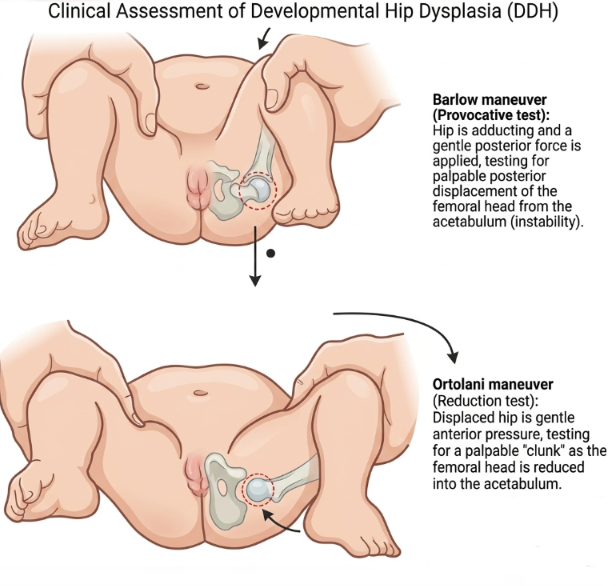
- Inspect leg position.
- Look for unequal leg lengths, asymmetrical skin folds and limited hip abduction.
- Perform Barlow and Ortolani tests only if trained.
- Each hip should be examined separately.
- A positive Barlow or Ortolani test requires specialist referral and hip ultrasound.
Developmental dysplasia of the hip risk factors
- Breech presentation
- Family history
- Female sex
- Oligohydramnios
- First-born baby
Back and Spine
Turn the baby carefully while keeping them warm and supported. Examine the entire back from the neck to the sacrum.
Inspection
- Inspect the spine from the cervical region to the sacrum.
- Look for scoliosis or abnormal curvature.
- Look for sacral dimple, hair tuft, naevus, swelling, sinus, birthmark or visible spinal defect.
- Look for asymmetry of the gluteal cleft.
- Check for obvious spina bifida or meningocele.
Palpation
- Palpate gently along the midline of the spine.
- Feel for gaps, step deformity, swelling, masses or tenderness.
- Palpate around any sacral dimple to assess depth, position and associated skin changes.
- Do not probe deeply into a sinus or suspicious dimple.
- A high, deep, hairy, large, draining or atypical dimple needs senior review and further assessment.
OSCE point
A simple low sacral dimple close to the anus is usually benign. A high, deep, hairy, large, draining or atypical dimple may suggest occult spinal dysraphism and needs further assessment.
Neurological Examination and Primitive Reflexes
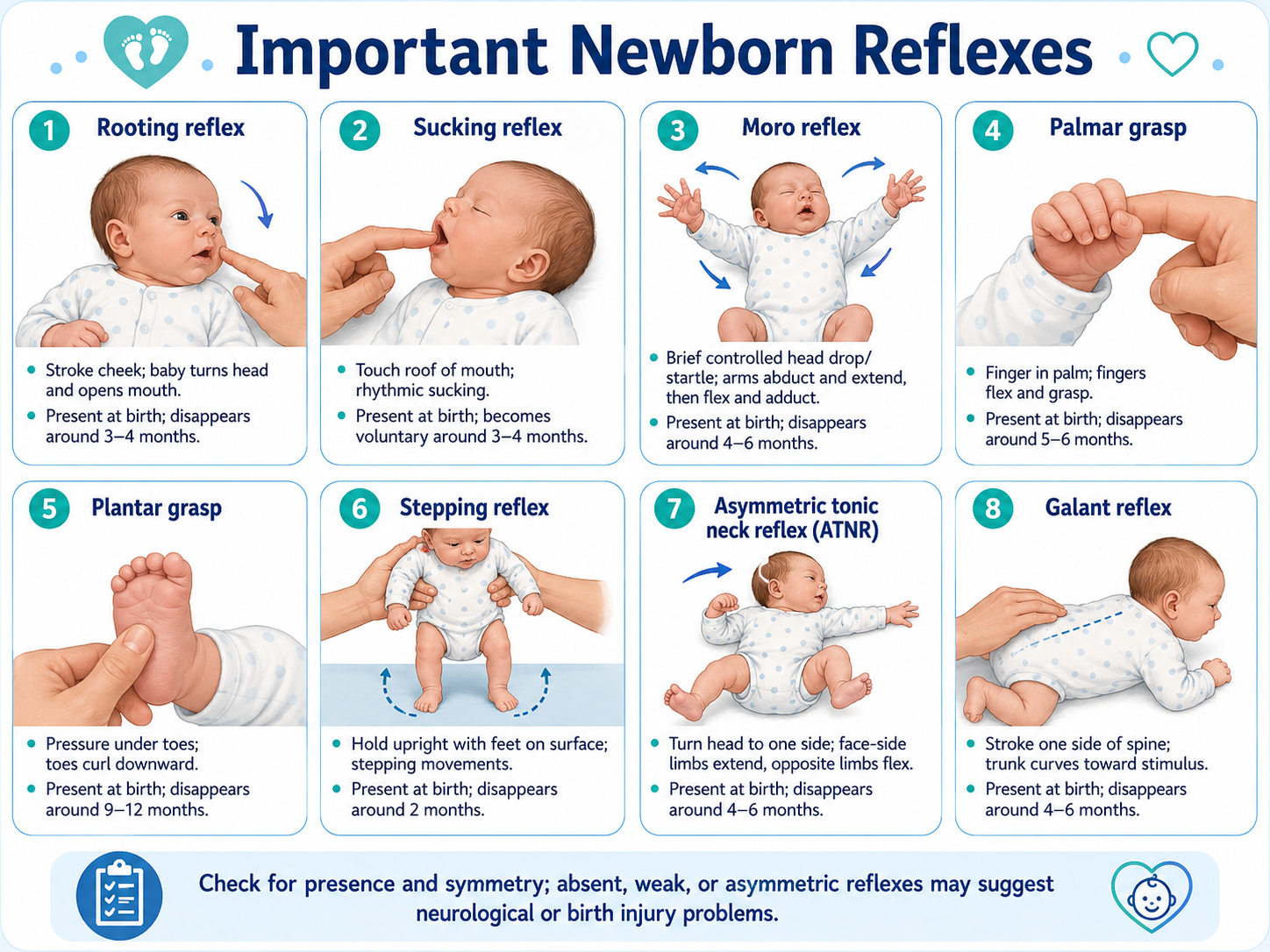
Assess neurological status throughout the examination. Look at alertness, cry, posture, tone, symmetrical movement, feeding ability and responsiveness.
| Reflex | How to elicit | Normal response | Timing |
|---|---|---|---|
| Rooting reflex | Stroke the cheek or corner of the mouth. | Baby turns towards the stimulus and opens the mouth. | Present at birth; usually disappears by 3–4 months. |
| Sucking reflex | Touch the roof of the mouth with a nipple, teat or gloved finger. | Rhythmic sucking. | Present at birth; becomes voluntary by around 3–4 months. |
| Moro reflex | Allow a brief controlled head drop while supporting the baby safely. | Arms abduct and extend, then flex and adduct. The baby may cry. | Present at birth; usually disappears by 4–6 months. |
| Palmar grasp | Place a finger in the baby’s palm. | Fingers flex and grasp the examiner’s finger. | Present at birth; usually disappears by 5–6 months. |
| Plantar grasp | Apply pressure under the toes. | Toes curl downward. | Present at birth; usually disappears by 9–12 months. |
| Stepping reflex | Hold the baby upright with the feet touching a flat surface. | Baby makes alternating stepping movements. | Present at birth; usually disappears by around 2 months. |
| Asymmetric tonic neck reflex | Turn the baby’s head gently to one side while supine. | Limbs on the face side extend while the opposite limbs flex. | Present at birth; usually disappears by 4–6 months. |
| Galant reflex | Stroke one side of the spine while the baby is prone. | The trunk curves towards the stimulated side. | Present at birth; usually disappears by 4–6 months. |
OSCE tip
Focus on rooting, sucking, Moro, palmar grasp and plantar grasp. Always compare both sides. Asymmetry is more concerning than mild variation in strength.
External Signs of Maturity
Assess whether the baby appears consistent with the stated gestational age.
- Skin texture
- Lanugo
- Ear cartilage recoil
- Breast tissue
- Plantar creases
- Genital maturity
- Muscle tone
- Posture
A term baby usually has well-formed ears, good recoil, visible plantar creases, mature genitalia and better flexor tone.
Newborn Screening Before Discharge
Confirm that routine newborn screening has been arranged or completed according to local policy.
- Screening for critical congenital heart disease
- Hearing screening
- Screening for hyperbilirubinaemia
- Blood spot screening for metabolic, endocrine, haematological or genetic conditions
Screening programmes vary by country, so local or national guidance should be followed.
Red Flags
- Central cyanosis
- Severe respiratory distress
- Grunting or apnoea
- Poor feeding
- Lethargy or seizures
- Temperature instability
- Poor perfusion
- Weak or absent femoral pulses
- Significant murmur with symptoms
- Absent or abnormal fundal reflex
- Bilious vomiting
- Abdominal distension
- Failure to pass urine
- Failure to pass meconium
- Ambiguous genitalia
- Bilateral undescended testes
- Jaundice in the first 24 hours
- Abnormal tone
- Asymmetrical limb movement
- Positive Barlow or Ortolani test
- Major congenital abnormality
Closing the Examination
- Cover and dress the baby.
- Make sure the baby is warm and safe.
- Thank the parent.
- Explain your findings clearly.
- Ask if the parent has any questions.
- Wash your hands.
- Document the examination findings.
Example normal summary
“Your baby’s examination is reassuring. The heart, lungs, abdomen, hips, eyes, spine and neurological examination are normal. I have not found any concerning features today.”
Examiner Questions
When should the newborn examination be performed?
Before discharge, usually within the first 24–72 hours of life.
What is the Apgar score used for?
It assesses the newborn’s condition shortly after birth using appearance, pulse, grimace, activity and respiration.
Should resuscitation wait for the Apgar score?
No. If the baby needs resuscitation, start immediately.
Why do we check the fundal reflex?
To screen for serious eye pathology such as congenital cataract, retinoblastoma, retinal abnormality or corneal opacity.
Why are femoral pulses important?
Weak, absent or delayed femoral pulses may suggest coarctation of the aorta.
What are signs of respiratory distress in a newborn?
Tachypnoea, grunting, nasal flaring, recession, tracheal tug, head bobbing, cyanosis and difficulty feeding.
What are risk factors for developmental dysplasia of the hip?
Breech presentation, family history, female sex, oligohydramnios and first-born baby.
Why is jaundice in the first 24 hours concerning?
It is pathological until proven otherwise and may be due to haemolysis, infection or other serious causes.
What should you do if the baby has bilious vomiting?
Treat it as a surgical emergency. Arrange urgent senior review, keep the baby nil by mouth, obtain IV access, start fluids, insert a nasogastric tube if indicated and arrange urgent imaging.
What spinal findings require further assessment?
A high, deep, hairy, large, draining or atypical sacral dimple, swelling, sinus, hair tuft, abnormal pigmentation, spinal deformity or neurological abnormality requires senior review.
Final Summary
The newborn examination is a structured head-to-toe assessment performed before discharge. The most important findings not to miss are central cyanosis, respiratory distress, abnormal fundal reflex, weak femoral pulses, abdominal distension, bilious vomiting, failure to pass urine or meconium, ambiguous genitalia, abnormal hips, abnormal spine, abnormal tone and signs of sepsis.